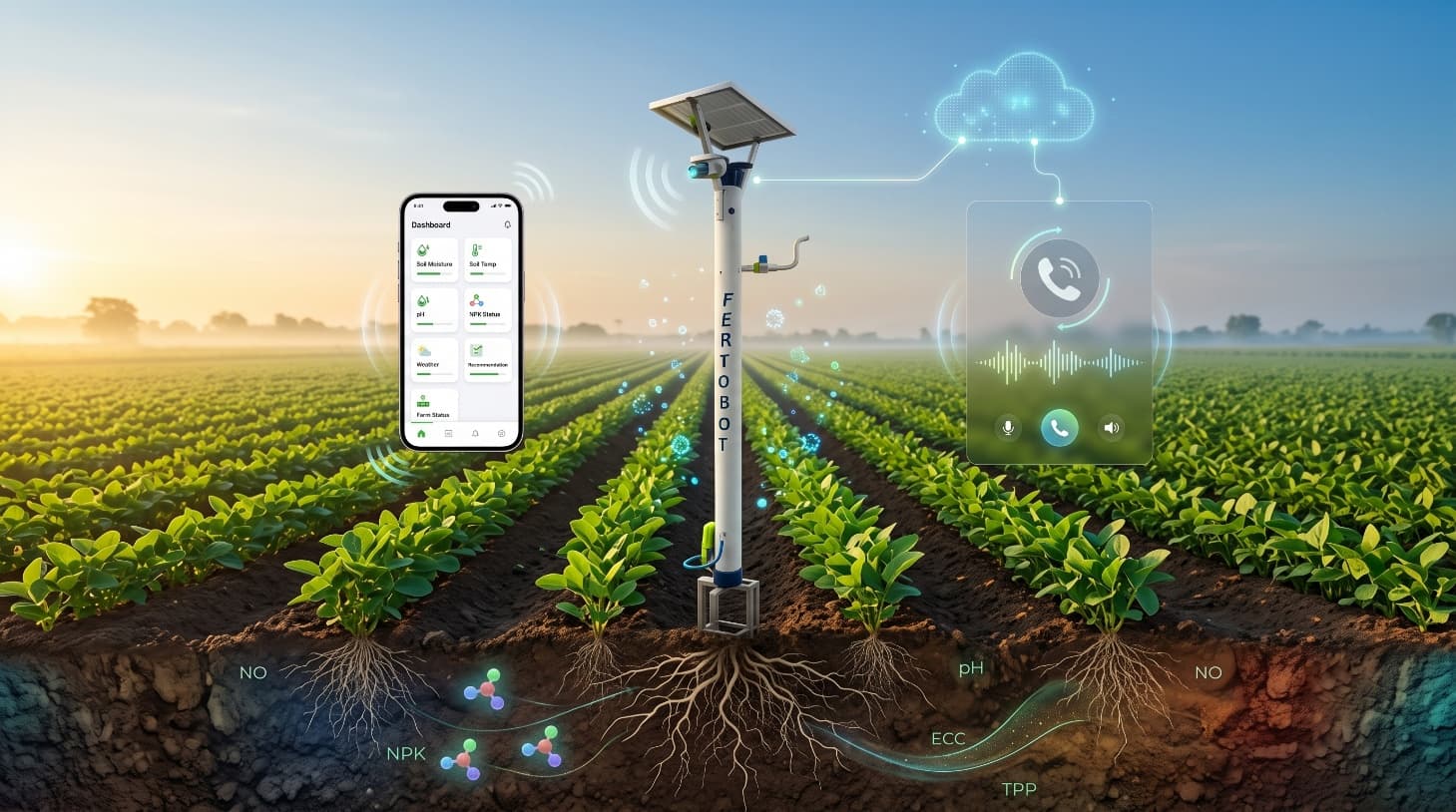
A random farmer in Punjab would determine their crop irrigation schedules according to the same ancient technique as that of their predecessors – by instinct, by the calendar, and by looking up at the sky.
Now there is something novel lying in the field – a tiny box with a solar power source inserted into the soil. The device keeps monitoring the soil condition throughout the day and even calls the farmer at any time on an ordinary phone in the language he understands, telling him precisely what his plants require.
FertoBot is made by an Indian startup company HexPrs LLP. In this guide, you will learn about its features, working principle, price, and future prospects of smart agriculture in India.
Quick Fact
India's precision agriculture market was worth about USD 334 million in 2025 and is expected to grow to around USD 739 million by 2034.
Key Takeaways
- Watches soil health 24/7 and tells farmers exactly when to water & apply fertilizer.
- FertoBot operates on a simple, intuitive loop: Sense, Analyze, Act, Assist.
- Handles pesticide spraying automatically on its own, but only after explicit farmer consent.
- Integrates automated voice calls in local languages - no smartphone is required.
- Helps achieve massive resource savings: 25-35% on fertilizers & 30-60% on water.
- Hurdles are infrastructure-based (patchy internet, monsoon elements) rather than technology.
Why Smart Farming Matters Right Now
The agriculture sector in India is faced with the issue of the "leaky bucket." In most cases, farmers will not manage to utilize more than half of the nitrogen fertilizer they apply. The rest is either lost through evaporation, runoff, or deep percolation below the root zones.
Even water is not spared: traditional flood irrigation methods cause losses of up to 60 percent of the water used. This causes significant waste of money for the farmers every single year, and is the reason why the agritech sector is developing rapidly in India.
Did You Know?
Flood irrigation - still common across India - can lose up to 60% of the water applied to evaporation and runoff.
How We Got Here: A Quick Timeline
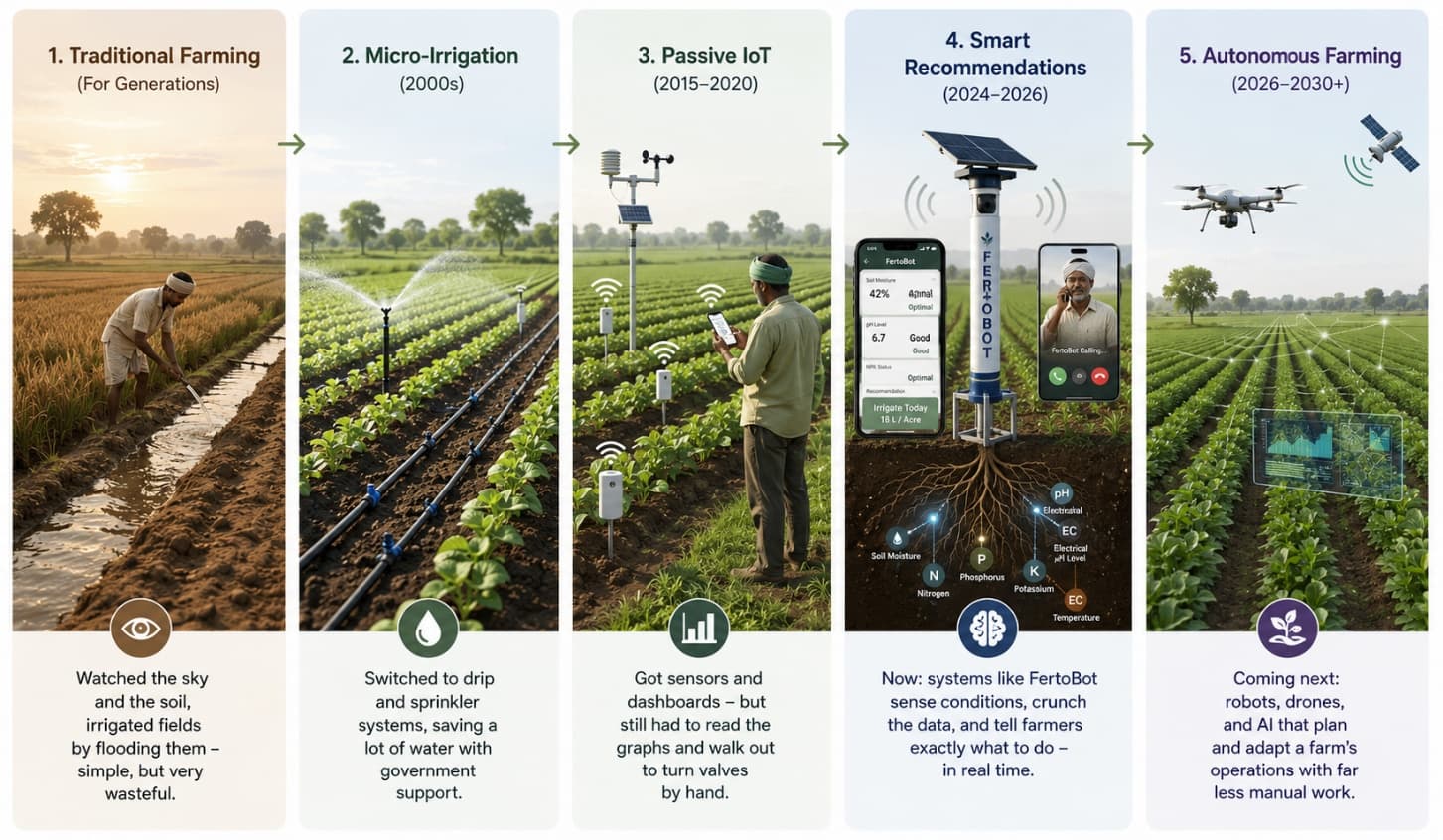
Farming technology in India didn't jump straight to AI. It moved through a few clear stages over the past generations:
| Era | What Farmers Did / Technology |
|---|---|
| Traditional (generations) | Watched the sky and the soil, irrigated fields by flooding them - simple, but very wasteful. |
| Micro-Irrigation (2000s) | Switched to drip and sprinkler systems, saving a lot of water with government support. |
| Passive IoT (2015-2020) | Got sensors and dashboards - but still had to read the complex graphs and walk out to turn valves by hand. |
| Smart Recommendations (24-26) | Now: systems like FertoBot sense conditions, crunch the data, and tell farmers exactly what to do in real time. |
| Autonomous Farming (2026-30+) | Coming next: robots, drones, and AI that plan and adapt a farm's operations with far less manual work. |
A Few Terms Worth Knowing
You don't need an engineering background to follow agritech, but a few terms come up often. Here's a plain-English glossary:
| Term | In Simple Words |
|---|---|
| NPK | Nitrogen, Phosphorus, and Potassium - the three main nutrients every crop needs to survive and yield. |
| Fertigation | Feeding a crop liquid fertilizer directly through the same water it's irrigated with. |
| EC (Electrical Conductivity) | A stand-in measurement. The sensor estimates soil nutrients from how well the damp soil conducts electricity. |
| Edge Computing | Processing telemetry directly on the device in the field, without needing to wait for a round trip to cloud servers. |
| Digital Twin | A virtual copy of your farm that lets you test different schedules (like watering frequency) safely on screen first. |
How FertoBot Actually Works
FertoBot runs on a simple, automated four-step loop. Think of it like a highly dedicated farmhand who never sleeps, never guesses, and always checks with you before executing anything critical:
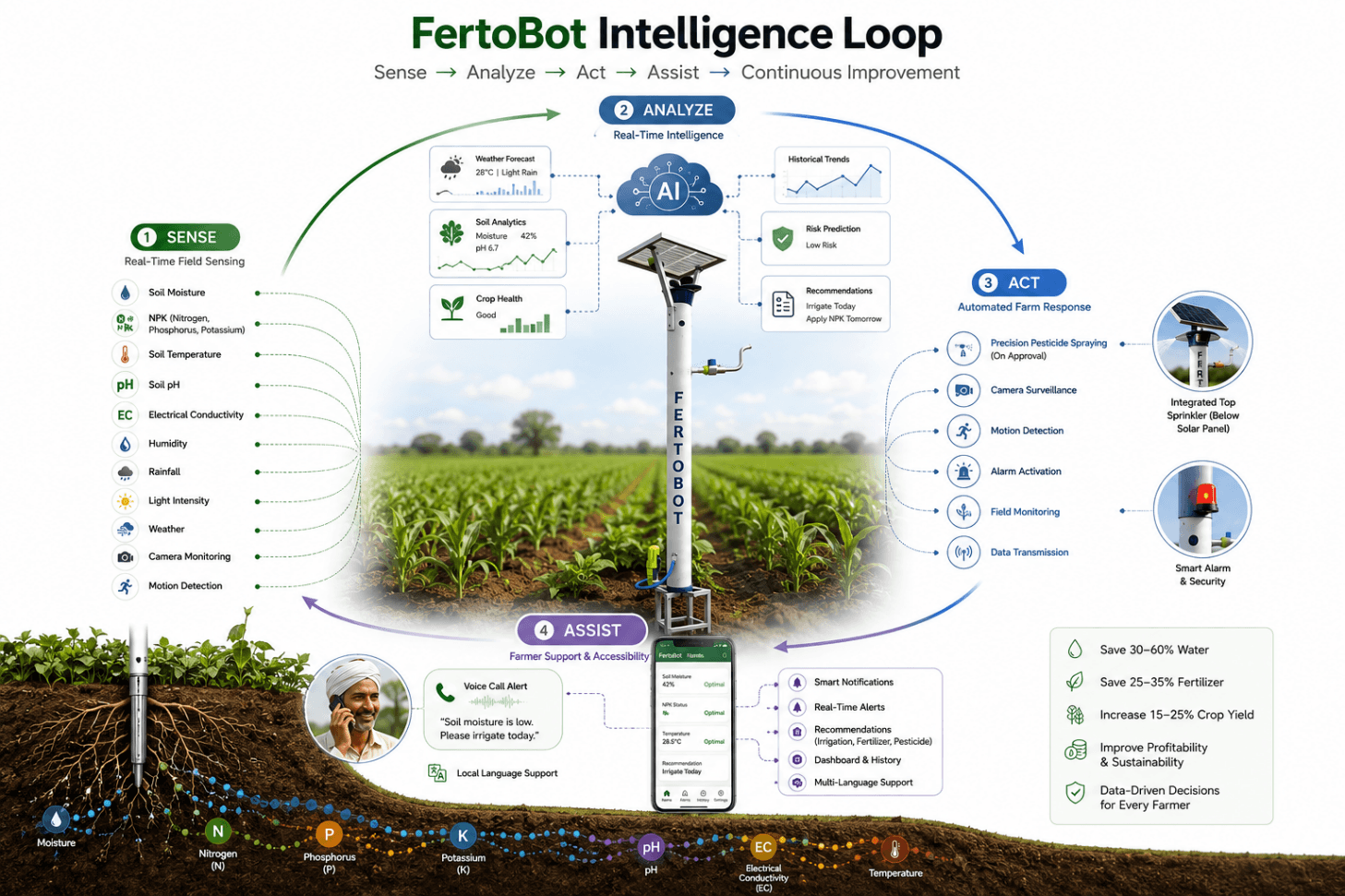
Sense
Telemetry sensors embedded in the soil measure moisture levels, temperature, EC estimated pH, NPK trends, and surrounding micro-climates.
Analyze
Local algorithms compare today's readings to historical baseline metrics and digital forecasting models to determine what the field lacks.
Act
FertoBot activates pesticide micro-spraying automatically - but only after the farmer taps 'approve'. It also sounds a security alarm for intruders.
Assist
The device calls the farmer's basic phone or sends an app alert in the farmer's native language specifying exactly how much water and fertilizer to apply.
What FertoBot Does and Doesn't Do
Important Note
FertoBot intelligently monitors farm conditions, analyzes real-time data, and recommends irrigation and fertilizer decisions. The one job it performs fully on its own is pesticide spraying, and only after the farmer approves it.
What FertoBot Does
- Watch soil moisture, nutrients, and weather nonstop
- Tell you exactly how much water and fertilizer to apply
- Spray pesticide automatically, after you say yes
- Watch for intruders and sound an alarm automatically
What FertoBot Doesn't Do
- Turn on irrigation valves by itself
- Apply fertilizer without you doing it
- Spray pesticide without your approval
- Replace the need for any farm fencing or staff
Keeping the Farm Safe
Cameras paired with motion sensors watch the field for wild boars, stray cattle, or unwanted visitors. If something trips the sensor, FertoBot turns on an alarm automatically - no approval needed here, since there's nothing to apply to the crop and security response is time-critical.
What the Sensors Can (and Can't) Do
Here's something worth knowing: most soil sensors, FertoBot included, don't run a lab-quality chemical test on your soil. They estimate nutrient levels using electrical conductivity and electronic signals, then apply a calibrated formula to calculate the numbers.
In Simple Words
The sensor doesn't directly measure nutrients. Instead, it estimates them using electrical properties in the soil - which makes it great for spotting trends, but not a replacement for a lab test.
Things like soil type, salt content, and temperature can all nudge these readings around. That's why the real value isn't any single reading - it's watching how the numbers move over weeks and months, identifying trends rather than single data points.
What Farmers Actually Gain
Deploying a soil intelligence system offers direct financial and environmental payoffs:
Fertilizer bills cut down by 25-35%; yield gains average around 20% on monitored fields.
Water consumption drops by 30-60% when paired with automated drip irrigation.
Fewer chemical runoffs lead to healthier ground soil and less local pollution.
Fewer manual, time-consuming field checks and less guesswork-driven wasted effort.
Voice calls in local languages mean farmers without high-end smartphones aren't left out.
Where It Still Struggles
Like any new technology, deploying high-tech diagnostic devices in real Indian fields comes with hurdles:
| Challenge | What's Being Done About It |
|---|---|
| Patchy internet in rural areas | The device keeps monitoring locally and syncs data once a GPRS connection returns. |
| Heat, dust, and heavy monsoon rains | Industrial-grade, weatherproof hardware built for outdoor conditions (IP67 certification). |
| Sensor readings drift over time | Regular remote software recalibration and baseline updates keep numbers accurate. |
| Upfront cost | Government subsidies and shared usage through Farmer Producer Organizations (FPOs) spread the cost. |
Old-School vs. Smart Farming
| What Matters | Flood Irrigation | Manual Drip System | FertoBot-Style Smart Farming |
|---|---|---|---|
| Water efficiency | Very low (up to 60% lost) | High (30-40% saved) | Very high (up to 60% saved) |
| Decisions made | Guesswork & tradition | Fixed timers | Real soil data + weather |
| Labor needed | Very high | Moderate | Low - mostly for applying recommendations |
| Pest protection | Manual guarding | None | Automatic alarms + approved spraying |
| How you're informed | Not at all | Manual gauges | App + voice call in your language |
The Bigger Picture: Agritech in India
India's agritech industry represents a huge, mostly untapped opportunity worth an estimated $24 billion, with less than 1% of that market potential tapped so far. Several states are rapidly developing hubs for startup integration:
| State | What Stands Out |
|---|---|
| Maharashtra | Leads with over 1,300 registered agritech startups, fueled heavily by high-value grape and pomegranate farming. |
| Gujarat | Around 700 agritech startups and growing fast due to dryland farming technologies. |
| Karnataka | Just over 600 startups, but pulls in roughly two-thirds of all agritech funding as the country's IoT and robotics hub. |
Is FertoBot Right for You?
A Small Farmer
The voice-call feature means you don't need a smartphone, and saved input costs matter most on thin margins.
Running a Commercial Farm
Bigger acreage means bigger absolute savings on labor, water pump energy, and bulk fertilizer inputs.
Greenhouse / Polyhouse Operator
Tighter environment control makes real-time moisture and micro-climate recommendations even more valuable.
High-value Crop grower (Grapes, etc.)
Small percentage efficiency gains translate into very large absolute rupee gains per season.
Part of a Farmer Group (FPO)
You can share one telemetry system's cost across many neighbouring members to reduce upfront burden.
Agribusiness or Investor
Field-level data helps with planning, production forecasting, and remote due diligence.
Does It Pay for Itself? A Quick Example
Take one hectare of grapes in Maharashtra. Normal growing costs run about Rs. 11.2 lakh, with roughly Rs. 3.1 lakh of that going to fertilizer and chemical plant protection alone.
| Item | Estimated Impact |
|---|---|
| Lower fertilizer & chemical costs | ~Rs. 62,000 saved |
| Lower irrigation costs (pump electricity, water sourcing) | ~Rs. 40,000 saved |
| Higher production yield (~5%) | ~Rs. 1,01,810 extra revenue |
| Total Annual Benefit | ~Rs. 2,03,810 per hectare |
| Deployment Cost (Year One) | ~Rs. 1.5 lakh per hectare |
| Payback Period | ~9 months |
Think About It
This example is specific to grapes in Maharashtra. Your own numbers will shift with your crop, region, and water costs - but the shorter payback period for high-value crops is a consistent pattern.
Myth vs. Reality
| Myth | Reality |
|---|---|
| NPK sensors do a lab-quality chemical test. | They estimate nutrients using electrical signals - great for trends, not a lab replacement. |
| You need a smartphone to benefit. | A voice call in your own language works on any basic mobile phone. |
| FertoBot waters and fertilizes the field on its own. | It tells you exactly how much to apply - you or your existing drip controls still do the physical applying. |
| Automation removes the farmer from decisions. | The farmer remains in command, approving the one fully automatic action: pesticide spraying. |
| This only makes sense for big corporate farms. | Savings scale with how much you already spend on inputs, not just overall farm size. |
Frequently Asked Questions
What's Coming Next
Over the next several years, expect farms to get even smarter - not just monitoring conditions, but predicting them before they happen:
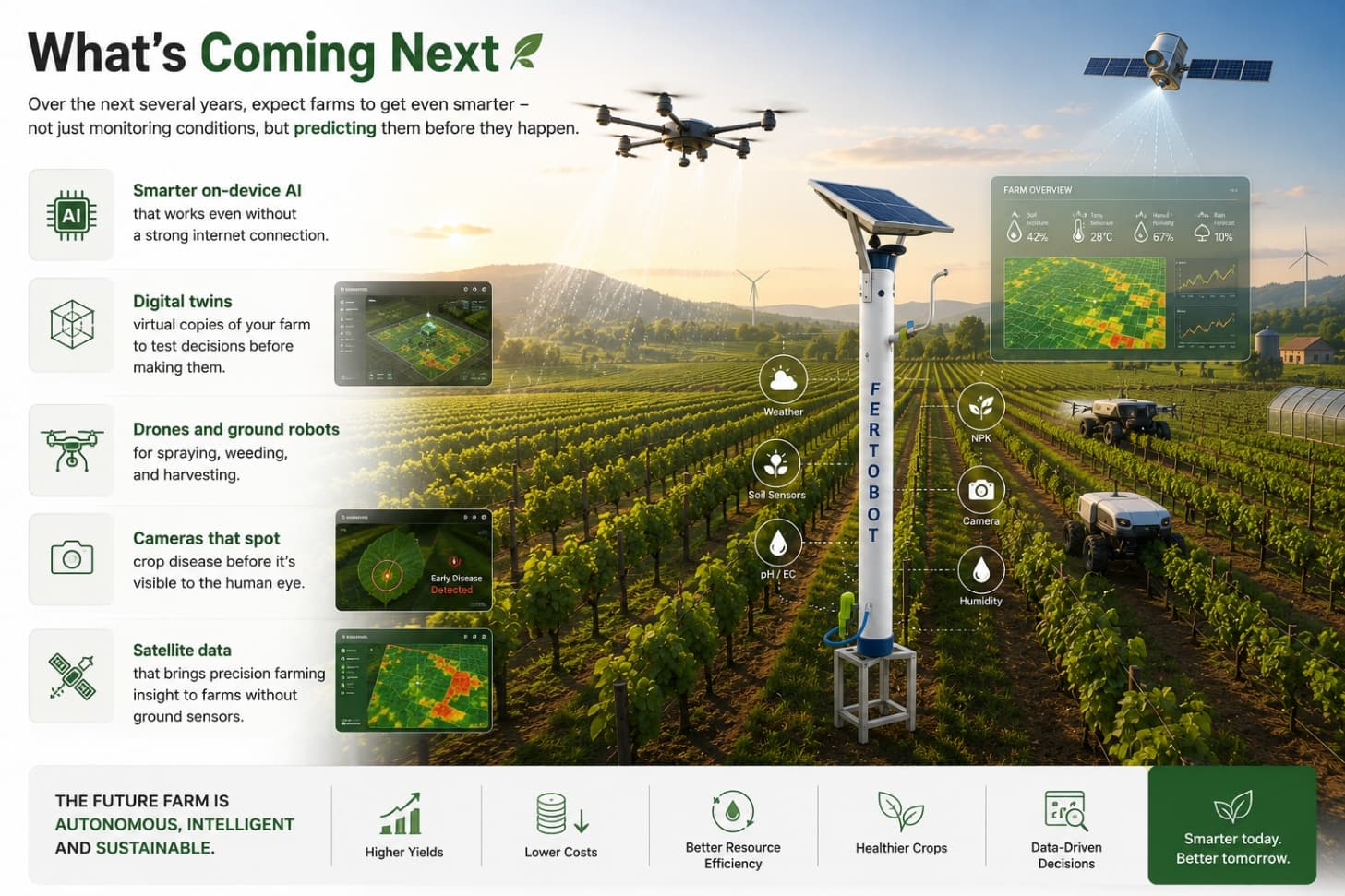
- Smarter on-device AI that works even without a strong internet connection.
- Digital twins - virtual copies of your farm to test decisions before making them.
- Drones and ground robots for spraying, weeding, and harvesting.
- Advanced Cameras that spot crop disease before it's visible to the human eye.
- Satellite data that brings precision farming insight to farms without ground sensors.
The Bottom Line
Smart farming is not about taking away jobs from farmers; rather, it is about providing them with timely and relevant information in the form most convenient to them. The FertoBot observes, analyzes the data, provides recommendations, and performs the single task – spraying pesticides – only with your approval.
However, the path is not smooth – connectivity issues, difficult weather conditions, and initial costs exist. However, the technology becomes cheaper, stronger, and smarter each year and that is why smart farm technologies are becoming an integral part of the Indian agriculture industry.
About HexPrs LLP
HexPrs LLP is an Indian agritech company behind FertoBot, built around a simple idea: precision farming should work for every farmer, not just the ones with a smartphone and a strong internet connection.
See It on Your Own Farm
Curious how this would work on your fields? Reach out and we'll set up a demo.
Schedule a Live Soil Diagnostics Demo
Email us today to book your farm visit.